
Despite rising prices, Austrians still enjoy skiing and continue to take traditional winter holidays.
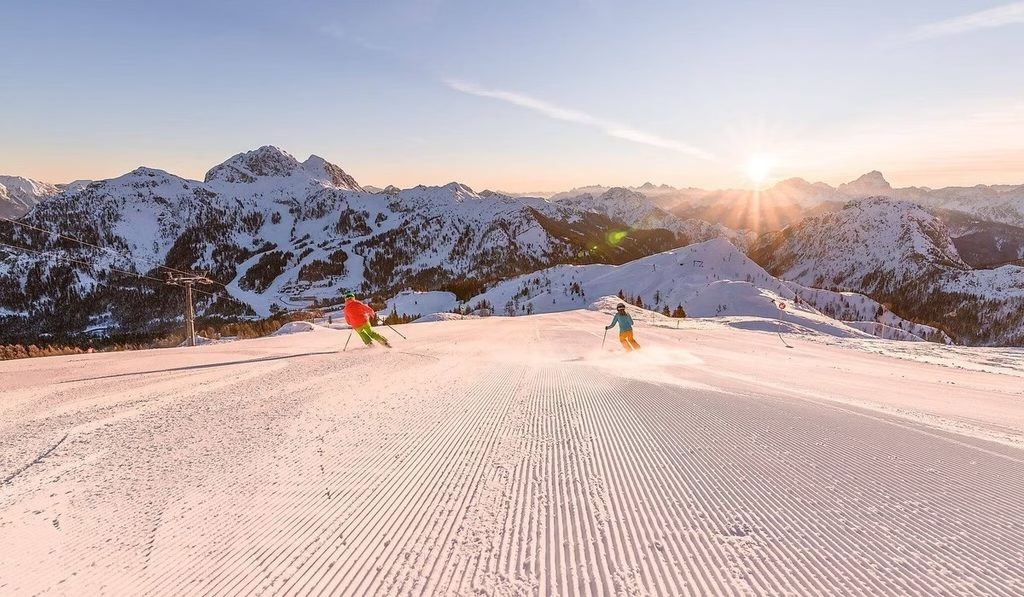
The debate surrounding rising ski ticket prices resurfaces every year: The question of whether skiing is becoming increasingly unaffordable for families with children or low-income individuals stirs up strong feelings. This season, the €85 mark for day tickets will be broken for the first time, meaning that the vast majority of Austrians – 86 percent – definitely consider skiing a luxury sport that only the wealthy can afford.
This is the result of a representative survey of 1,000 Austrians aged 16 and over, conducted by the Institute for Demoscopy & Data Analysis (IFDD) for Ski Guide Austria. The survey also aims to clarify which challenges the industry faces and what new offerings businesses and regions should develop to ensure that this leisure activity, so vital to the domestic economy, continues to have a successful future.
The most important point first: As sobering as the 86 percent (90 percent for women) may seem at first glance, they are put into perspective upon closer inspection. After all, 41 percent of those surveyed participate in a snow sport. Among 30- to 50-year-olds, this figure rises to 53 percent; only among those over 50 is it a meager 32 percent. Also interesting: Snow sports apparently fascinate more men (48 percent) than women (34 percent). When it comes to the type of snow sport, skiing is unchallenged as number one at 86 percent – for both women and men. This also applies to snowboarding (10 percent), which is slightly more popular among 30- to 50-year-olds (19 percent) – while women slightly outnumber men in cross-country skiing (15 percent) and ski touring (17 percent). Freeriding (2 percent), on the other hand, is predominantly a male domain. The industry can also take heart from the fact that 44 percent of snow sports enthusiasts pursue their hobby at least regularly (1-2 weeks), frequently, or very frequently (more than 3 weeks per year). A further 56 percent do so at least on a daily basis.
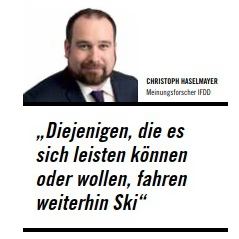
For IFDD head Christoph Haselmayer, these figures mean that skiing remains part of everyday culture despite all the discussions about rising costs: „Of course, 85 euros is subjectively expensive. But those who can afford it, or want to, continue to ski. And at least 11 percent explicitly do not see it as a luxury.“ The decision is ultimately also a matter of personal priorities: Although skiing in Austria is still relatively inexpensive compared to other countries, the money spent on a week's ski vacation in the Austrian mountains could easily buy a winter holiday in a warm-water destination. „The perception of price“ is certainly „clear,“ the pollster concludes. But at least 14 percent of Austrians are currently planning a ski or winter vacation. Even though 77.5 percent of Austria's winter tourism now relies on foreign visitors, 14 percent isn't exactly impressive: On the other hand, considering the total population over 16, this still equates to more than a million potential ski vacationers. And then there are the children, both young and old. Overall, it can be said that the number of local skiers and holidaymakers is relatively stable, although a slight downward trend is noticeable.
A classic winter holiday in Austria is primarily booked for skiing (54 percent) and to spend time with family and friends (27 percent). Wellness and relaxation are also important motives at 8 percent; cross-country skiing (3 percent) or winter hiking (1 percent) are less so. The much-discussed and especially popular après-ski, particularly among foreign guests, plays a more minor role for Austrians: For 6 percent, it's a main motivation – and these are almost exclusively men under 30 (19 percent). Those up to 50 years old (3 percent) are less likely to participate in the après-ski scene. Conversely, a full 59 percent can imagine a ski holiday without après-ski. Surprisingly, this figure also applies to 67 percent of those under 30. Haselmayer: „This isn't a contradiction, however, because there's a general trend among many young people towards less alcohol.“ Visits to mountain huts offering regional cuisine during a ski holiday, on the other hand, are quite important. For 39 percent, it is very or highly important, and for only 25 percent is it not important at all. 22 percent state that they intend to use rental equipment such as skis, ski boots, or helmets; this figure is slightly higher among 30- to 50-year-old city dwellers with a high school diploma.
That price is a key factor in ski holidays is also evident in the fact that 49 percent say they want to save on ancillary expenses such as restaurants and mountain huts – that's a full 5 percentage points more than last year. And what's even more concerning: only 12 percent rate the value for money of a winter holiday as very good or good; 32 percent as average.
That's also 5 percentage points less than last year. For 48 percent, however, the situation is bad or very bad. Countermeasures are needed here if the cable car companies, regions, and tourism businesses don't want to gradually lose locals as winter guests in the long run. Of course, there are also numerous small ski resorts with affordable rates (about which you can read more in the 2027 edition of the Ski Guide Austria), as well as promotional offers from the industry giants. Nevertheless, the IFDD head believes „ski resorts and municipalities are called upon to do even more in this direction and ensure that there are enough affordable and easily accessible options for families and locals.“ This is crucial, he says, simply to secure the next generation of skiers.
Snow reliability is a must: 44 percent of the total population (including non-skiers) consider artificial snowmaking very or quite important. Significantly more men (55 percent) than women (34 percent) share this opinion. Haselmayer: „Apparently, the economic importance of the industry for the national economy is recognized.“ Opinions are divided on dynamic pricing, which is now used in many ski resorts: 34 percent like it, 39 percent dislike it. And of the 19 percent who have already experienced it, only 35 percent report positive experiences, while 62 percent report negative ones. There is clearly room for improvement regarding transparency in terms of offerings and prices. And last but not least, a positive sign for Austria's winter tourism: despite the climate debate, 52 percent still consider skiing to be relevant today.
In conclusion, a broad but price-sensitive core market emerges: focused on clear offers and simple planning, with high expectations for a good
Value for money, tangible added value on site, and guaranteed snow cover. Those who deliver on these points will score points in the coming years.
Seasons, says IFDD boss Haselmayer.