
In the run-up to the 10th Tyrolean Eagle Forum on September 22, 2026, the Tyrolean Eagle Round Table discussed the Austrian reform backlog and necessary political changes.
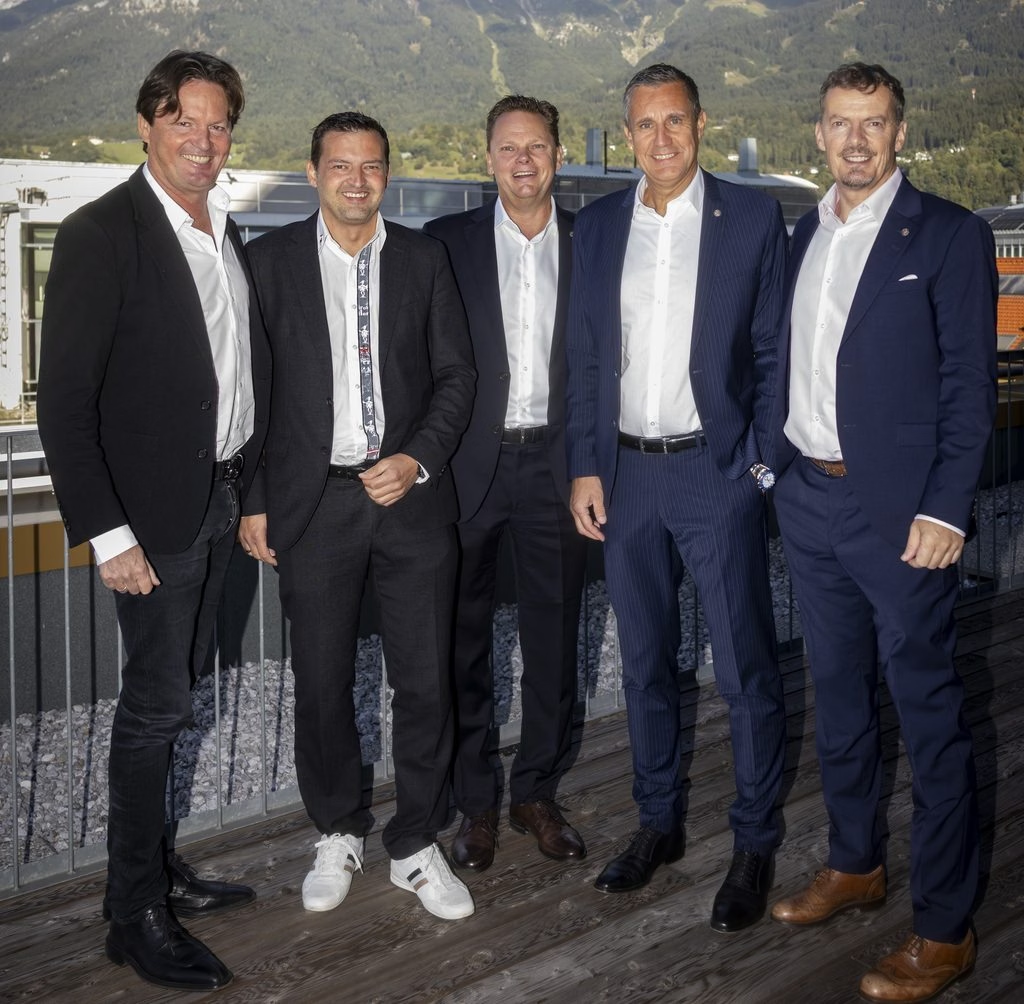
Austria is increasingly perceived as an administrative state where responsibilities are more important than results and processes more important than impact, according to the Adler board. The business leaders cited the intertwining of competencies between the federal government, states, and municipalities, a dense network of interest groups, and political veto positions as structural causes. This makes it difficult to assign responsibility, and reforms are watered down to the lowest common denominator. Even the social partnership – once a successful model – now often acts as an additional veto player. Short election cycles also encourage a policy of inaction.
The Tyrolean Eagle Round He also pointed to economic warning signs: Government spending is around 55 percent, and the tax burden is about 44 percent. At the same time, national debt is over 80 percent of GDP – even though Austria has one of the highest tax burdens in Europe. "We don't have a revenue problem, but a spending problem," summarized Klaus Mark, press spokesman for the Tyrolean Adler Roundtable. "This isn't the result of isolated political missteps; Austria's inefficiency is systemic."„
The group also sees this as a locational problem: Austria is losing competitiveness, while industry, trade, and the construction and real estate sectors are suffering from high costs, lengthy procedures, and a lack of planning certainty. Companies are postponing investments or relocating them abroad. High energy costs are a particular burden for energy-intensive businesses.
He who pays, decides – he who decides, is responsible.
The group formulated a central demand for a clearer distribution of responsibilities between the federal government, the states, and municipalities. Based on the principle "whoever pays, decides – and whoever decides, is responsible," responsibilities, financing, and political accountability should be more clearly linked. "Federalism is fundamentally sensible, but it needs clear fiscal sovereignty," explained Christian Handl, President of the Tyrolean Adler Roundtable. Furthermore, the group called for the reduction of existing regulations: New rules should only be introduced if existing burdens are simultaneously eliminated – according to the "one-in, two-out" principle. A bureaucracy review should examine which rules are necessary and which are dispensable. "Digital administration must move from buzzword to reality," said board member Gottfried Sint. Estonia was cited as one of the best examples.
According to the Tyrolean Adler Roundtable, the reform agenda also includes a pension reform linking the retirement age to rising life expectancy, a tax reform focusing on relief for work and performance, and an education reform with greater school autonomy and a stronger focus on STEM subjects and dual vocational training. The welfare state must once again reward performance more effectively. Tax relief should be financed through spending cuts rather than new taxes.
Reforms as a future project
The Tyrolean Adler Roundtable also called on the business community to take responsibility. The debate about the reform gridlock should not be conducted solely as a settling of scores with politicians. Businesses and their representative body, the Chamber of Commerce, have too often accepted what they should have rejected. Austria is capable of reform, the business leaders concluded. However, instead of managing stagnation, shaping the future must become a core government policy.