
Early season start thanks to snowmaking secures billions in value in winter tourism: Austria is a top global destination that is unparalleled.
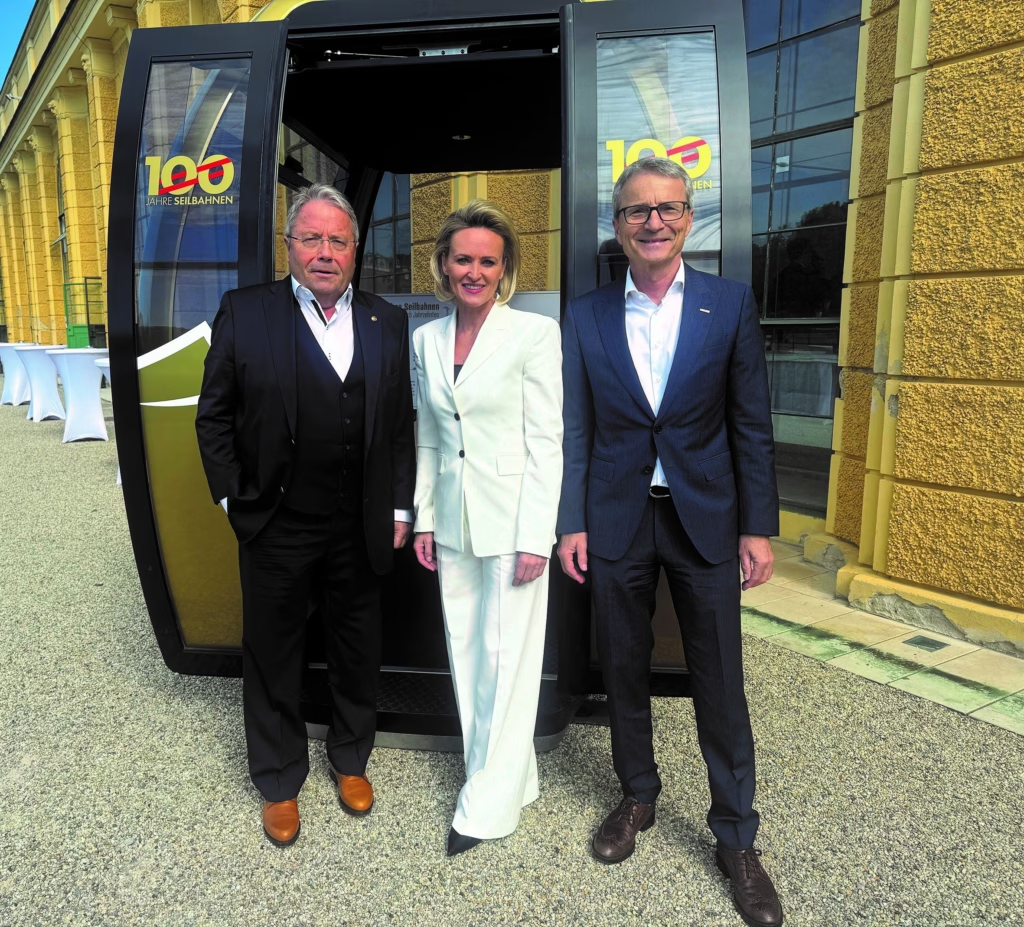
Austria's cable car companies can look back on a successful winter season in most of the country's ski resorts. Coinciding with their 100th anniversary, the companies recorded a season that at least matched, and likely surpassed, the success of the pre-pandemic seasons. The early start to the season, thanks to artificial snowmaking, made a significant contribution to this success. This generated a total of €1.2 billion in added value and approximately 8.7 million overnight stays.
Current projections for the past winter season of 2025/26 indicate approximately 54 million first-time visitors – making it one of the best winters ever for Austrian cable cars. "This puts us about four percent above last year's figure," says Franz Hörl, Chairman of the Austrian Cable Car Association at the Chamber of Commerce. By the end of January, the industry was almost six percent above the previous year's level, reaching the record level of the winter of 2019/20. While February didn't quite maintain this momentum, it still showed an increase of more than two percent. Only March, with a decrease of 6.6 percent, caused a slight dip in the outlook for the post-season.
A significant factor in this success was the high coverage of ski resorts with the latest energy-efficient snowmaking technology. A recent analysis by MANOVA confirms this: the economic importance of the early winter season is often underestimated – yet millions of overnight stays and billions in revenue depend directly on snow reliability. The winter season doesn't begin economically in January, but rather in November and December. In these two months alone, Austria's mountain regions recorded around 12.2 million overnight stays in 2025 (8.7 million of which were by skiers) – a record high compared to previous years.
At the same time, the analysis clearly shows how strongly this demand is linked to alpine winter sports: Around 71 million guests travel during this period primarily for alpine winter sports (skiing, snowboarding, freeriding). Snow reliability on the slopes is one of the most important decision criteria when choosing a ski resort – without the necessary conditions, a large proportion of guests would stay away. Without artificial snowmaking, large parts of this early season business would not have been possible. Specifically, around 8.7 million overnight stays and 10.4 million ski days would have been lost. The economic consequences would have been massive: With average spending of €264 per ski day, this would have led to a gross revenue loss of around €2.74 billion. The sectors most affected would have been accommodation (around €940 million), cable cars (€460 million), transportation (€400 million), and restaurants (€380 million).
However, the impact extends far beyond tourism. The loss of the early season would have resulted in a net loss of approximately €1.19 billion in added value, accompanied by tax revenue losses of around €380 million. This clearly demonstrates that artificial snowmaking is not an add-on service, but a crucial prerequisite for a successful start to the season – and thus for stability, employment, and added value in entire regions.
At the cable car conference, the industry celebrated its 100th anniversary, which began with the construction of the Tyrolean Zugspitze cable car and the Rax cable car in 1926. The association's quality label, "Best Austrian Summer Cable Cars," also celebrated its 25th anniversary. "What began in 1926 as a pioneering technical project has become a key driver of value creation, employment, and regional development in Austria," said Erik Wolf, Managing Director of the association. Since the first cable car in 1926, alpine regions have fundamentally changed. "What was once characterized by isolation, emigration, and a lack of economic prospects has developed into vibrant living and economic spaces. Cable cars not only connect places but also create identity and a future: Where they have been built, businesses have grown, families have stayed, and entire regions have flourished. They are therefore far more than just infrastructure – they are a crucial prerequisite for quality of life in rural areas," said Erik Wolf. Today, their economic importance is clearer than ever: around 54 million overnight stays and well over 50 million skier days per winter, as well as a value creation of approximately €6.7 billion in winter, are directly linked to the industry. A total of 128,000 jobs depend directly or indirectly on cable cars. Their impact extends far beyond tourism – every euro invested generates many times that amount in regional value creation. "This means that cable cars are not only the backbone of winter tourism, but also a crucial pillar for employment, regional stability, and economic development in Austria," says Wolf. This immense significance is also underscored by the head of the industry association, Franz Hörl: "100 years of cable cars in Austria represent more than just technological history. They tell a story of courage, innovation, and the will to connect spaces – economically, socially, and culturally!"„
Initial details of the anniversary campaign were also presented. "The industry is celebrating together with the companies celebrating their anniversaries. We also want to use this opportunity to convey the emotion of cable cars, provide factual information about the industry, and above all, celebrate together with our customers," said Managing Director Erik Wolf. In addition to the anniversary website 100jahreseilbahnen.at and a social media campaign, Austria's cable cars will also have a visible presence in public spaces in the coming months. "The campaign will be complemented by a competition unique in the industry, in which the public will have the chance to win a very special anniversary prize," Wolf added.
And presenter Alexandra Meissnitzer, Olympic gold medalist, two-time world champion, and overall World Cup winner, also had words of praise for the industry at the cable car conference. "For many years, I traveled internationally in the world of skiing and experienced a wide variety of winter sports destinations – from North America to Asia. Austria occupies a special place in this comparison: The cable cars stand for the highest technical precision, continuous innovation, and a level of service that is unparalleled worldwide," said Meissnitzer. "Whether for everyday training or competition – the Austrian systems have always been reliable. This quality is no accident, but the result of decades of experience and consistent development," Meissnitzer continued. "Austria is a global leader in the field of cable cars. We can not only be proud of this – it is also a strong foundation for the future of winter sports and alpine tourism."„