
This year, Austria's cable cars are jointly looking back at their roots. The Rax cable car and the Tyrolean Zugspitze cable car will celebrate their 100th anniversary in 2026, followed the next year by the Pfänder cable car, the Feuerkogel cable car and the Schmittenhöhe cable car.
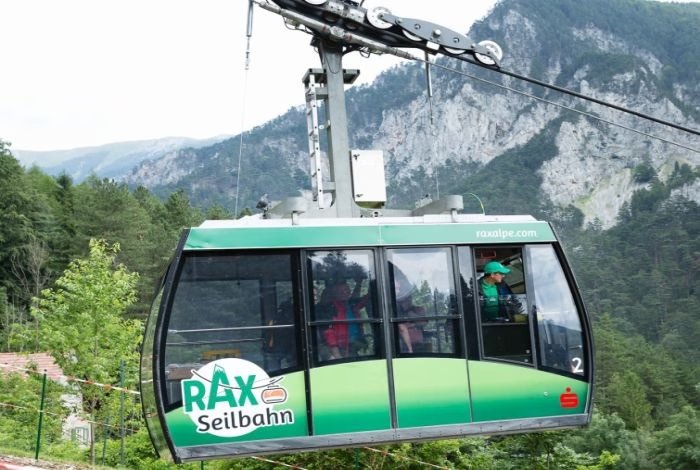
What began with great daring, pioneering spirit, and technical skill has since developed into one of the country's most successful industries, because soon after their initial use for transporting materials, cable cars became an effective means of transporting people. Initially used primarily for summer visitors, hikers, and spa guests in the Alpine regions, the Zugspitze cable car and the Rax cable car were already operating for public passenger transport. This marked the beginning of a success story that soon spread to other regions of the country with the construction of the first chairlifts and ski lifts.
Parallel to the growth of tourism, the lift infrastructure also developed rapidly. Initially, these were mostly single-cable aerial tramways, meaning cabins that traveled in opposite directions on a single cable. After the construction was halted by the Second World War, a true tourism and cable car boom began. Skiing became a national sport, drag lifts spread rapidly, and from the 1960s onwards, the technological leap towards chairlifts and aerial tramways followed.
Technological innovation as a constant companion
A defining characteristic of cable car systems is that technological innovation has always been a driving force, inextricably linked to the ever-increasing importance of tourism. Detachable chairlifts and gondola lifts based on the single-cable circulating principle not only increased comfort but also the potential of ski resorts. New high-tech systems with weather protection hoods, fully automated controls, and heated seats followed, as did high-capacity 8- and 10-person gondola lifts and spectacular 3S cableways. All of these share the common features of now comprehensive renewable energy supply and high operational efficiency.
Today, 2,526 cable car systems across Austria provide over 50 million skier days annually, making Austria, along with the USA and France, one of the world's largest providers of skiing experiences. "Without the outstanding technical achievements in cable car construction, the development of tourism into one of the most important regional economic drivers would have been inconceivable. Reason enough to celebrate this 100th anniversary in style and to look to the future with positivity and confidence," said Franz Hörl, Chairman of the Austrian Cable Car Association.