
Austria's "Alliance Future Winter" has united the economic beneficiaries of winter sports tourism across various sectors for many years: mountain railways, the hospitality industry, ski schools, and, last but not least, the ski industry and sporting goods retailers. For over 20 years, the annual high-level forum has taken place at the end of November in Kaprun-Zell am See, where participants meet amongst themselves and with representatives from the media to discuss key findings. As usual, the Ski Guide Austria was part of this select group.
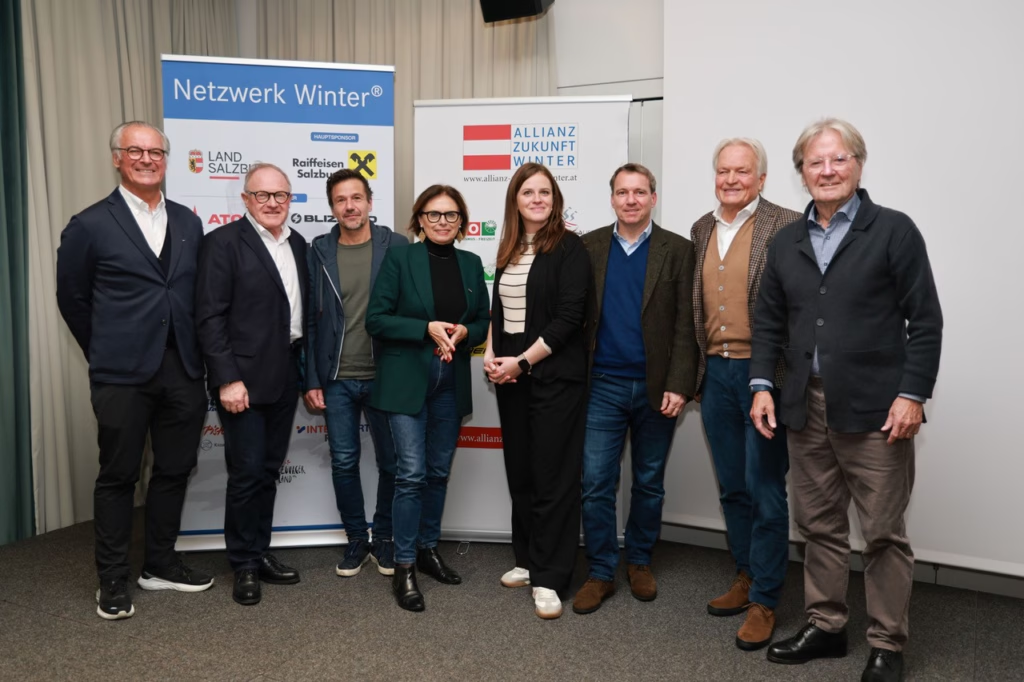
Former State Secretary Susanne Kraus-Winkler, now spokesperson for the tourism sector at the Austrian Federal Economic Chamber (WKÖ), underscored the economic importance of winter tourism for Austria with key figures: Approximately one-seventh of the global ski market is located in Austria; only the USA and – in most years – France have more "skier days." Winter visitors spend around €238 per day in Austria – about €50 more than summer visitors. However, Kraus-Winkler cautioned against ignoring the signs of the times: "Neither price nor demand can be increased indefinitely."„
Positive outlook
Austria's forecasts for the current winter season are quite positive. Austria's leading position in Europe as a winter sports destination is undisputed and is confirmed by a special analysis of the Austrian National Tourist Office's (ÖW) Winter Potential Study 2025/26: 16.5 million people from ten European countries are planning a holiday in Austria in the winter of 2025/26, 9.1 million of them specifically for skiing or snowboarding. In eight out of ten European markets, Austria ranks among the top two most popular winter sports destinations. Furthermore, 70 percent of European guests who spend their winter sports holidays in Austria attest that Austria offers the best value for money.
However, to secure and expand Austria's leading position as a winter sports destination, it's crucial not to rely solely on Germany and other nearby markets. According to the latest studies by the Austrian National Tourist Office (ÖW) on winter visitors from the USA and China, six out of ten US winter sports enthusiasts are interested in a winter sports holiday in Europe. The ÖW is advocating a proactive approach, as Austria already ranks fourth among the most attractive winter destinations outside the USA for US winter sports enthusiasts and second worldwide for Chinese respondents.
The economic importance of winter tourism for Austria was highlighted in a recent study focusing on the venue of the "Alliance Future Winter" forum. There, not only hotels and restaurants depend on the snow – the entire town benefits massively from visitors. Sixty-six hotels and numerous restaurants together generate approximately €105 million in added value and nearly 1,000 jobs. Of the average overnight stay, calculated at €192, €119 contributes to regional economic growth. This calculation takes into account that every euro generated in the hospitality sector triggers 29 cents in revenue in other industries. Particularly impressive in the study, conducted by Prodinger Tourism Consulting on behalf of the Austrian Federal Economic Chamber's Tourism Division, is the fact that revenues contribute €6.4 million to the coffers of the municipality and tourism association in Zell am See, in addition to €22.4 million in other taxes and fees. The net income of employees totals €27.4 million.
Ski guests from all over the world
„Furthermore, 150 million people practice alpine skiing on at least three to four days a year. And we expect the market to grow,” summarized Wolfgang Mayerhofer, CEO of the Atomic Group and spokesperson for the Austrian ski industry, highlighting the global dimension. A comparison with golfers is interesting. The 60 million registered golfers worldwide play on 35,000 courses, while there are just over 6,000 ski resorts. The differences in land use are less striking: An 18-hole golf course in Central Europe requires an average of 69 hectares, while Austria's 314 ski resorts, with an average of 8 lifts each, utilize 79 hectares.
According to consultant Richard Bauer, 78% of ski tourists now live in major cities; they tend to be spontaneous and open to new experiences: "Meeting others in the real world, experiencing something together – that's the perfect leisure activity for young urbanites." This is also reflected in the documented use of AI. Teresa Karan, Head of Innovation at the Austrian National Tourist Office, explains: "Our winter potential study showed that, on average, over 10% of visitors to Austria already use ChatGPT or other AI applications for their travel planning. Among winter sports enthusiasts, this figure climbs by another 50% to 16.9%."„
For years, Manova has been researching for the cable car industry what particularly influences a guest's choice of a specific ski resort. This allows them to quantify the factors that determine a ski resort's demand potential: The basic capacity of the lifts and businesses contributes only 39%, followed by 13% sunshine, 12% snow conditions, and 9% temperature, while altitude itself accounts for only one percent. "But a crucial element is missing from this list: emotion. Because ultimately, it's about whether the guests are happy," says Manova Managing Director Klaus Grabler. So, what forms the overall guest opinion in winter tourism? Grabler is convinced that, with the support of artificial intelligence and machine learning, they can now better determine the factors behind this assessment. The existing "mountain of data" is enormous, accumulated over years and through numerous studies. This data reveals how skiers move through the ski area, which parts are particularly popular, which routes are avoided, and even how preferences change during multi-day stays. „By learning from the guests, the cable car companies will also be able to optimize their investment,” says Grabler.
The focus is on atmosphere and slopes.
However, Grabler has to disappoint his clients somewhat with one result from the guest surveys: only one-tenth of the overall winter holiday experience can be attributed to the immediate quantity and quality of the ski lifts. Atmosphere/winter experience and the slopes themselves are perceived as significantly more important, each scoring around 19 points. Accommodation (7.5 points) and mountain restaurants (7.3 points) also contribute significantly to the success of the ski holiday. While not insignificant, the ski pass offers, at 5.3 points, are surprisingly secondary in the selection process, given the annual price debate. This also applies to other "secondary aspects" that are frequently advertised: for example, the restaurants in the village (2.2 points) and the party scene (après-ski 3.9 points, nightlife 1.1 points). When considering what is crucial for satisfaction with the slopes, quantitative elements such as the length of the runs prove to be significantly more important than the search for sufficient space on the slope.