
More and more snowboarders, ski tourers, and skiers are seeking the thrill of off-piste powder. However, it's crucial to always be mindful of avalanche danger and the corresponding safety precautions.
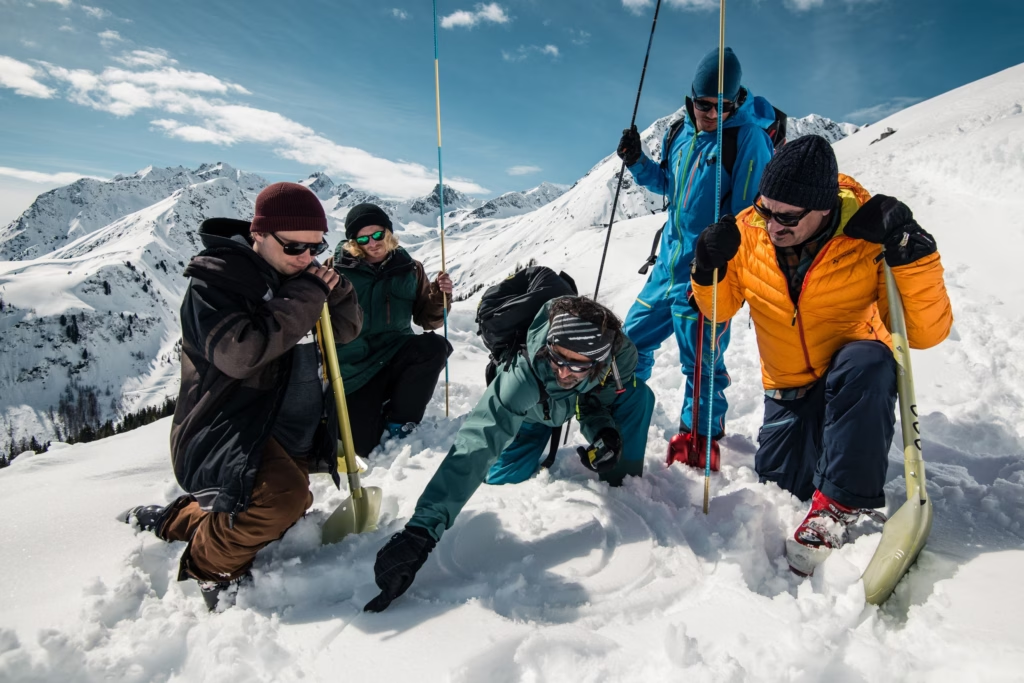
More and more snowboarders, ski tourers, and skiers are seeking the thrill of off-piste powder – and here, the risk of avalanches is a constant companion and can only be properly assessed with the appropriate knowledge. The greatest danger comes from slab avalanches. These are tensile "traps" of loosely bonded or wind-packed snow that, under the slightest pressure, can suddenly break away and slide across the slope on a slip layer. Even a very small slab avalanche can be life-threatening if you are below it or have triggered it yourself and are swept away headfirst.
It will be mandatory to obtain the avalanche report before venturing off-piste.
There are basically five avalanche warning levels.
- LEVEL 1: The snowpack is generally well-consolidated and stable. Triggering is generally only possible under heavy load on a very few, extremely steep slopes. Only small avalanches are possible spontaneously.
- LEVEL 2: The snowpack is only moderately consolidated on some steep slopes, otherwise generally well consolidated. Triggering is possible, especially on steep slopes, particularly with a large additional load. Large spontaneous avalanches are not expected.
- LEVEL 3: The snowpack is only moderately to weakly bonded on many steep slopes. Triggering is possible even with a small additional load, especially on the specified steep slopes. Occasionally, some medium-sized, and even isolated large, avalanches are possible. Warning level 3 signifies unfavorable conditions: 75 percent of avalanche accidents occur at level 3!
- LEVEL 4: The snowpack is weakly bonded on most steep slopes. Triggering is likely even with a small additional load on numerous steep slopes. In some cases, many medium and even large avalanches are to be expected spontaneously.
- LEVEL 5: The snowpack is generally weakly bonded and largely unstable. Numerous large avalanches are to be expected spontaneously, even in moderately steep terrain.
When it comes to avalanches, one should beware of the following misconceptions:
- I have never seen an avalanche come down this steep slope, so it is avalanche-safe.
- Nothing can happen on this small, short slope.
- Forests protect against avalanches; below the tree line it is not dangerous.
- There are no avalanches in extreme cold.
- Existing tracks in open terrain are by no means a guarantee of avalanche safety; in fact, the stability of the slope can decrease with each track. Avalanches are often only triggered on the fifth or sixth descent.
- Little snow does not mean low avalanche danger. Statistically speaking, winters with low snowfall claim a particularly high number of avalanche victims.
- The risk of avalanches persists even during prolonged periods of cold temperatures.
REACT CORRECTLY
If, despite all precautions, an avalanche occurs and there are people buried in the group, the rescue teams must be informed. The following five points must be communicated.
- Where: Description of the accident site
- What happened?
- When did it happen?
- What injuries and how many people are injured?
- Who will report and provide information about the location, weather, and landing possibilities for the helicopter?.
IF YOU ARE AFFECTED, YOU SHOULD
- Perform swimming movements during the avalanche to stay as close to the surface as possible.
- When the avalanche slows down, assume a crouching position (arms in front of your head). This creates an air pocket in case you are completely buried.
- After coming to a standstill, remain calm and assess the situation. If possible, free yourself. Conserve energy and breath!
- Don't shout, it wastes valuable air. Exception: You hear noises.
If others in the group are affected, determine where the buried individuals were last seen. Activate the avalanche transceiver and search systematically, as the chance of survival is 90 percent in the first 15 minutes, but only 25 percent after 35 minutes. However, the number one safety rule always applies: Entering open terrain should only be done with the necessary equipment – avalanche transceiver and shovel.