
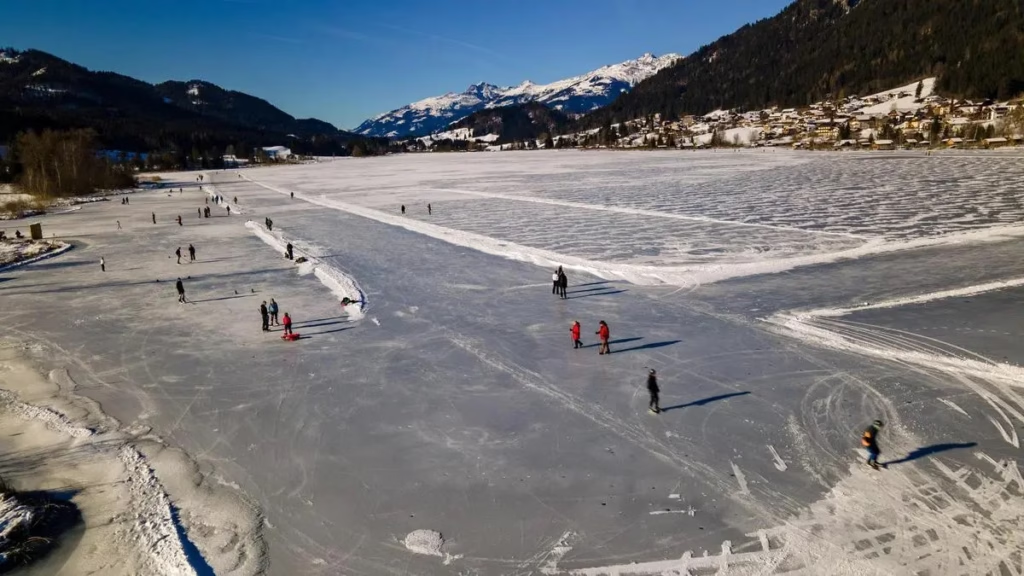
Norbert Jank is a true original – one known far beyond the borders of his home country. This is primarily due to the approximately 6,000 Dutch skaters who gather every year at the end of January for two weeks at Lake Weissensee in Carinthia for the alternative Eleven Cities Tour and the Dutch Speed Skating Championships – an event that not only generates around four million euros in revenue but also media coverage from around the globe. Right in the heart of this spectacle is Norbert Jank, who, as ice master, plays a particularly important role, ensuring that the many kilometers of ice rinks are in perfect condition and, above all, that the safety and load-bearing capacity of the ice are guaranteed. Although Jank is officially no longer active this winter season, he continues to support his successor with his decades of expertise.
JAMES BOND AND THE DUTCHMANS
Since 1967 – when Carinthia's first double chairlift was built on Lake Weissensee and winter tourism began to take off – the 77-year-old has been involved with the topic. Back then, he took the first guests across the frozen lake in a horse-drawn sleigh. Ice tourism really took off in the late 1980s: in 1987, part of the James Bond film "The Living Daylights" was filmed on Lake Weissensee. This six-minute sequence caught the attention of the Dutch, who were looking for a suitable location for their alternative Eleven Cities Tour. Because of the mild winters in the Netherlands, the canals and ponds needed for the tour no longer freeze over.
Following an initial visit by the organizers in 1988, who assessed the ice safety and infrastructure on site, 1,000 Dutch visitors flocked to Lake Weissensee the following year. "Back then, we had perfect ice from the western to the eastern shore, and the event was broadcast live on Dutch radio," Jank recalls of the early days. "Then television arrived, and the number of Dutch visitors grew steadily." So many, in fact, that Lake Weissensee, with its nearly 4,000 guest beds, no longer had enough space. "Now, the entire surrounding region benefits from this event," says tourism office manager Thomas Michor. "The Dutch are very important to us; it goes so far that hotels and restaurants adjust their menus during the two weeks."„
FREEZING IN STAGES
But back to the ice, without which the winter season at Lake Weissensee in its current form would be unimaginable: Maintaining and preparing the frozen water is practically a science, relies heavily on experience, and becomes more difficult every year, as Jank explained during a site visit in mid-January. The smaller western part of Lake Weissensee – only three to five meters deep – is frozen up to the Techendorf Bridge, while the much larger eastern part, reaching depths of up to 99 meters, remains frozen. "The lake will certainly freeze over, but whether it will be usable is another question," said the ice master. Last year was already very problematic: The lake froze over, but was unusable – repeatedly closed, partly due to water leaks. "This year we'll just have to wait and see." He couldn't say at the moment whether it would be better than last year. Up until New Year's Eve, temperatures often rose above freezing, and at night they only dipped one or two degrees below zero. Then, a week of normal temperatures. "At constant sub-zero temperatures of -10 degrees Celsius, the ice can grow one or two centimeters overnight. It also grows at -2 degrees Celsius, and at -15 degrees Celsius, it happens faster." Normally, the western part of the lake freezes over at the end of November, the eastern part a month later. These days, it's already taking a month and a half or two because it's not as cold. When the lake is completely frozen, it becomes the largest prepared natural ice surface in Europe, covering 6.5 square kilometers, and there's a 25-kilometer-long ice track that runs under the Techendorf Bridge.
INCREASINGLY MILD WINTERS
Since 1967, winters have been getting progressively warmer, explains Jank, who has been keeping records of ice duration and thickness since 1973: "I can still remember when I went to work at the sawmill 60 years ago, it was consistently between -20 and -30 degrees Celsius in January. My shoes squeaked when I walked – and the higher the squeak, the colder it was." Over the decades, it has become milder and milder. "These days, if it rains several times around Christmas and again in January, as it has in recent years, it's quite normal; nobody's surprised anymore." And we simply have to cope with these climatic conditions. "We try to make the best of it. Yesterday we knew it was going to rain today, so we worked late into the night finishing a few more kilometers of the track. We can't do anything today because it's too wet and slushy. So we'll keep working until the track is finished."„
A job that is certainly not without its dangers for Jank and his team: While the ice used to average around 40 centimeters thick – sometimes even up to 60 – these days they're happy with 25 or 30 centimeters. "That's perfectly adequate for the event. It would work with less, but then I have to be even more careful," says Jank, who puts the minimum at 20 centimeters or slightly less. After all, the load in the finish area, with structures, vehicles, and people, amounts to around 200 tons – equivalent to six truckloads in a row: "The load is comparable to a boat – the pressure is downwards, and then the water exerts counter-pressure on the ice – and that, of course, has to be closely monitored."„
INCREASED DANGER
It's always about the final assessment of how much weight the ice can support, says Jank. Despite all his observation and experience, he's fallen through several times: "I was always the first one out." Four cars and three large vehicles have been submerged so far – and three years ago it was a close call. He was driving a tractor at night when he noticed a crack in the ice and immediately afterwards the ice broke: "It was snowing, I couldn't even see the shore, I got out of the hole – I don't even remember how – and then stood there for five to ten minutes until one of the two tractors that were out clearing the ice arrived." A long time ago, he broke through the ice while snowplowing with a moped – in the eastern part of the country, six or seven kilometers away, in the middle of nowhere, Jank recalls: „I got out of the water; there was a long chain attached to the moped, I pulled it out, started it, and ran alongside it. Because at ten degrees below zero, I didn't dare get on it. I ran home and lay down in a hot bath and thawed myself out, so to speak. That's one of those events I still remember vividly.“
ALTERNATIVE OFFERS
Over the years, the risk has increased – including the risk that the alternative Eleven Cities Tour might one day no longer be possible. This could happen if it's no longer cold enough, explains Jank: "But nobody can say when that will be." Two years ago, nothing was possible during the first week of the tour because the ice was too thin and there was intermittent rain and snow. "We couldn't remove the snow because you can only use larger equipment on thick ice. It was only possible at the very last minute and with a lot of risk." Tourism expert Michor is also aware of climate change and its potential consequences. "We have an agreement with the Dutch organizers that the Eleven Cities Tour will take place here as long as there's ice. But of course, as a precaution, we're also considering alternatives in the direction of sustainable winter tourism."„